Buying or selling
Septic inspection when you buy or sell
Florida has no statewide rule requiring a septic inspection when a home sells, including in the Indian River Lagoon program area, but buyers should still ask for one. A full inspection pumps the tank, probes the drainfield and ends with a signed report. Add the 2030 questions: program area, sewer plans, grants and system type.
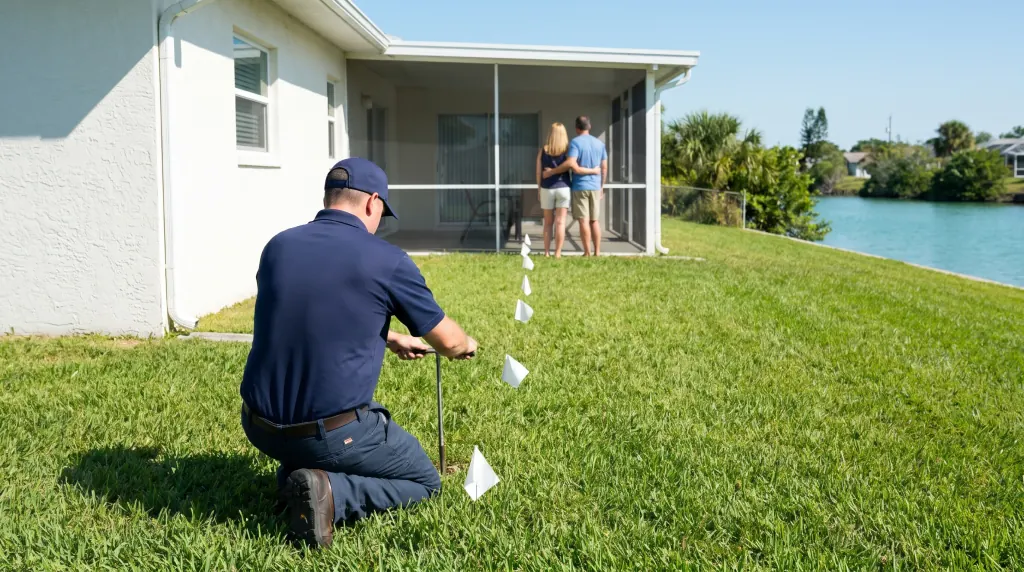
Is an inspection required at sale?
Not statewide. We found no Florida rule that requires a septic inspection or upgrade when a home sells. The state law that lets counties create periodic septic evaluation programs, s. 381.00651, Florida Statutes, says such an ordinance may not mandate an evaluation at the point of sale in a real estate transaction.
The Florida Department of Health in Indian River County still advises: if the home you are buying is on a septic system, ask for an inspection and assessment. The state's homebuyer guide says an evaluation lets repair costs be dealt with during sale negotiations.
One local rule is tied to sale: Vero Beach utility customers on septic must connect to the city's STEP sewer within one year of a sale or transfer, or by June 1, 2028, whichever comes first (City of Vero Beach document No. 2024-05). More on this in buying or selling a septic home.
What a septic inspection covers
Florida's Procedure for Voluntary Inspection and Assessment of Existing Systems (May 2000) sets the minimum standard. Unless you say in writing to skip parts, it includes:
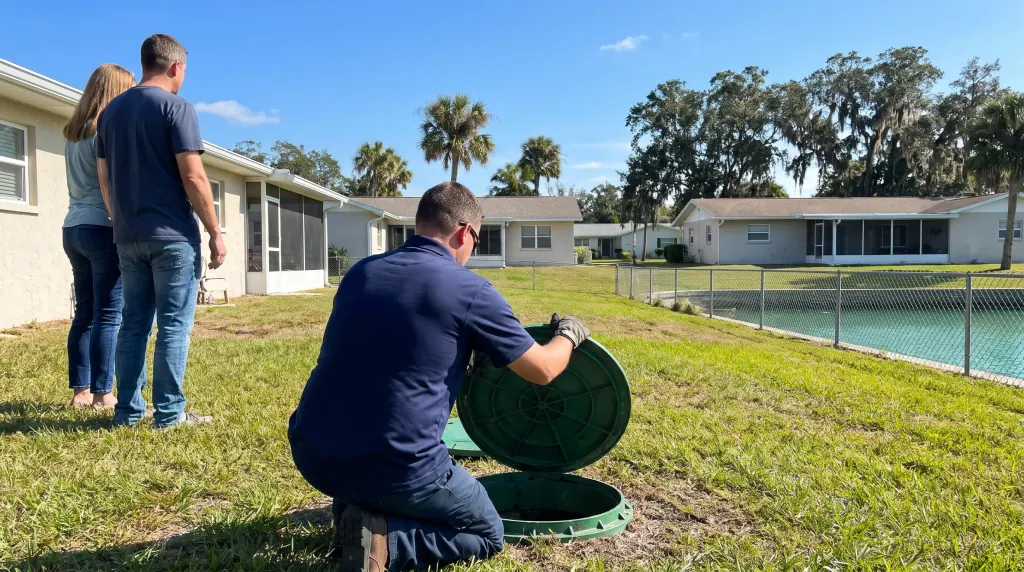
- Tank inspection. The tank is pumped to find its capacity, then checked empty for cracks, leaks and defects, intact baffles or tees, the outlet device and filter, and the fit of the lid. Pumping may be waived if there is proof of a pumping, or a permitted install, repair or modification, in the previous three years that states the tank size and condition.
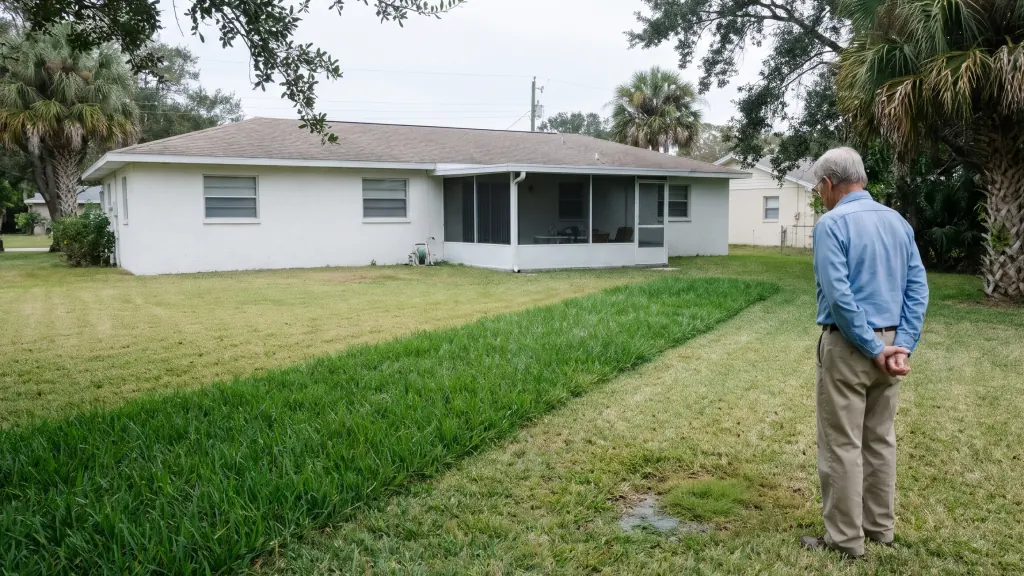
- Drainfield inspection. The drainfield is probed for location and approximate size, its type is noted, and the inspector looks for past failure, seepage, unusually lush grass, ponding and downspouts draining onto it. Soil is augered to estimate the seasonal high water table.
- Pumps and alarms, if present: the dosing tank, pump operation, the high-water alarm and electrical connections.
- A written, signed report to you and the owner.
By law, only a state-licensed septic tank contractor or plumber, or a certified environmental health professional, can inspect and assess the system. The evaluator must give you a copy of the procedure. A routine pump-out is not the same thing: it skips the drainfield and the report.
What fails an inspection
The state procedure does not grade pass or fail. The front of the report must say whether, in the inspector's opinion, the system is a sanitary nuisance: discharging untreated or poorly treated sewage, a badly built or badly kept tank, or conditions that breed flies or mosquitoes. It must also list maintenance the system needs.
The report must disclose these if found:
- Cracks, leaks or a poor fit in the tank, manholes or lid.
- Missing or damaged parts.
- Signs of past failure.
- Ponding over the drainfield or uneven spread of effluent.
- Downspouts or other water aimed at the system.
- A seasonal high water table at or above the drainfield, which the report must say raises the chance of malfunction.
- Anything on the site that could limit a future repair.
The health department does not get a copy and takes no enforcement action based on the report, according to the homebuyer guide. Fixing a problem does need a permit. If the fix is a repair or replacement, that is the natural moment to upgrade, and the permit office will remind you of the 2030 rule.
Who pays, and how long it takes
No Florida rule says who pays. It is a contract term. A buyer can order the inspection during the inspection period. A seller can order one before listing so the price already reflects any repair. Either way, agree in writing who pays and who picks the inspector.
No official time is published. The slow steps are uncovering the lids, pumping and probing the drainfield. Ask for the time on site and the date the signed report will be ready, and book early so the report arrives before your deadline. Price varies with tank size, access and whether pumping is included, so ask for a written price that lists what it covers.
The 2030 questions to add
An inspection tells you the system's condition today. It does not tell you whether the home must change systems by 2030. Under s. 373.469, homes on 10 acres or less inside the Indian River Lagoon program area must connect to sewer if available, or upgrade to ENR, by July 1, 2030. The law explained. Buyers and agents should also ask:
- Program area: is the parcel inside it? Run the address check.
- Plan area: North IRL, Central IRL, Banana River or Mosquito Lagoon. Permit rules have differed by area.
- Sewer plans: has the utility planned a line, sent a connection notice or set an assessment for this street?
- System type: conventional, or one of the three ENR types?
- ENR maintenance contract: for an aerobic unit, Rule 62-6.012, F.A.C., requires a current contract with an approved maintenance entity and service at least twice a year. Ask for the contract and service records.
- Grant eligibility: in Brevard, the county septic grant must be approved before work starts. Ask whether one was applied for or paid on the parcel. See grants.
Does this apply to your home?
The free address check answers in about ten seconds: inside the program area or not, septic or sewer on record, lot size and, in Brevard, a grant estimate.
Printable checklist
- Run the address check for the parcel.
- Get the septic permit and any repair permits from the county health department.
- Book a licensed inspector; confirm the full procedure (tank, drainfield, report) is included.
- Confirm the tank will be pumped, or get proof of pumping in the last three years.
- Ask for the tank size, drainfield type and water table estimate in the report.
- Read the report's front page: sanitary nuisance, yes or no.
- Get a written price for every repair the report lists.
- Ask the utility about sewer plans, notices or assessments for the street.
- For an aerobic unit, get the maintenance contract and service records.
- Ask whether a county grant was approved or paid for the parcel.
- Get a written estimate for the 2030 fix: sewer connection or ENR upgrade.
- Agree in writing who pays for the inspection and any repair before closing.
Check an inspector's registration on FDEP's contractor search, and see how to choose a septic company.
Closing on a septic home? Ask a licensed septic company that serves the area for an inspection and a 2030 estimate. The request goes to one company, free and with no obligation.
Your address, your answer
Find out what the 2030 rule means for your home
Type your address to see if it is inside the program area, whether state records show septic or sewer, your lot size and, in Brevard, an estimate of the county grant. Free, about ten seconds.
Questions people ask
Is a septic inspection required to sell a house in Florida?
Not statewide. We found no Florida rule that requires one at sale, and the state law that lets counties set up septic evaluation programs says those ordinances may not mandate an evaluation at the point of sale. Lenders or buyers can still ask for one, and Vero Beach has a sale rule for sewer connection.
Who pays for the septic inspection when selling a house?
No Florida rule decides it. It is part of your contract negotiation. A buyer can order one during the inspection period, or a seller can order one first so the price already reflects any repair. Put who pays, and who picks the inspector, in writing.
What will fail a septic inspection?
The state procedure does not use pass or fail. The signed report says whether the system is a sanitary nuisance, such as sewage surfacing or a badly built or kept tank, and lists repairs and maintenance. Cracked tanks, missing parts, drainfield ponding and a high water table must be written up.
How long does a septic inspection take?
No official time is published. The slow parts are finding the lids, pumping the tank and probing the drainfield. Ask the inspector for a time window on site and when the signed report will arrive, so it lands before your inspection period ends.
How much is a septic inspection when buying a house?
Prices vary with tank size, how hard the lids are to reach and whether pumping is included. Pumping can be waived if the seller has proof of a pumping or permitted work in the last three years. Ask for a written price that lists what it covers.
Does a good inspection mean the house is fine for 2030?
No. An inspection checks condition today. If the home is inside the Indian River Lagoon program area and still on a conventional system, it must connect to sewer or upgrade to ENR by July 1, 2030. Run the address check before you make an offer.
Sources
The laws, agency documents and reports this page relies on. Rules and grant amounts change; confirm with your county before you sign anything.
- Procedure for voluntary inspection and assessment of existing systems (May 2000), Florida Department of Environmental Protection
- Homebuyer's guide to septic systems (revised February 2015), Florida Department of Health
- Voluntary inspections, Florida Department of Health in Indian River County
- s. 381.00651, Florida Statutes: Periodic evaluation and assessment of onsite sewage treatment and disposal systems, Florida Senate
- STEP connection to central sewer by June 1, 2028 or within 1 year of sale (No. 2024-05), City of Vero Beach
- s. 373.469, Florida Statutes, Florida Senate
- HB 1417 (2026), Chapter 2026-2, Laws of Florida, Florida Senate
- Rule 62-6.012, F.A.C.: Standards for the construction, operation, and maintenance of aerobic treatment units (effective June 21, 2022), Florida Department of State
- Save Our Indian River Lagoon: septic system upgrades (archived March 5, 2026), Brevard County
- Septic tank contractor registration links (contractor and business search), Florida Department of Environmental Protection
Related
Buying or selling a home with septic
What buyers, sellers and agents near the Indian River Lagoon should check about septic and the 2030 rule: inspections, sewer plans, grants, sale rules.
Septic tank pumping and the 2030 rule
How often to pump a septic tank in Florida, what pumping costs, who may pump it, and five questions to ask the pumper about the 2030 Indian River Lagoon rule.
How to choose a septic company
Check a Florida septic contractor's registration, ask about ENR and permits, get written quotes and spot red flags before the 2030 Indian River Lagoon upgrade.
Septic tank and drainfield repair in the lagoon area
Septic repair inside Florida's Indian River Lagoon area: what a repair permit triggers today, the 2030 notice, repair or replace, and when to call a pro now.